There is a specific kind of frustration that comes from standing before a closet full of clothes and feeling as though nothing quite works. You might have pieces that are technically expensive, or items that follow the current season’s silhouette perfectly, yet the overall effect feels unpolished, restless, or somehow “off.” Often, this disconnect isn’t caused by a lack of style, but by a misunderstanding of the structural pillars that support a truly cohesive wardrobe.
When we speak of quiet luxury—or more accurately, understated style—we are moving away from the dopamine hit of a loud logo or a fleeting trend. Instead, we are looking at the quiet intelligence of a garment: how it moves when you walk, how the light hits the weave of the cloth, and how the lines of the clothing interact with the lines of your body. To achieve this level of discreet polish, one must master three fundamental elements: fit, fabric, and proportion.
Understanding these three pillars allows you to transition from simply “buying clothes” to “building a wardrobe.” It shifts the focus from what is new to what is lasting.
The Foundation of Fit: Beyond Size Labels
The most common mistake in modern dressing is equating size with fit. A size 6 in one brand may require entirely different adjustments than a size 6 in another, because “fit” is not a static number; it is a relationship between a two-dimensional pattern and a three-dimensional human form.
In an intentional wardrobe, fit is the difference between a garment looking like it was bought and a garment looking like it belongs to you. Even the most exquisite fabric will look cheap if the shoulder seam is drooping two inches too low, or if the waistline pinches in a way that disrupts the natural flow of the body.
The Nuance of Tailoring and Ease
Fit exists on a spectrum between “tight” and “oversized.” The middle ground—where true elegance often resides—is defined by “ease.” Ease is the intentional space between your skin and the fabric that allows for movement and prevents the cloth from pulling.
For example, consider a well-made wool blazer. A blazer that is too tight will create horizontal tension lines across the chest and abdomen, signaling discomfort. A blazer that is too large will swallow the frame, losing the intended silhouette. The ideal fit honors the body’s natural shape while providing enough breathing room to ensure the fabric drapes cleanly.
Key Areas to Watch
When assessing the fit of a new piece, look closely at these high-impact zones:
- The Shoulders: The seam should ideally sit at the natural end of your shoulder bone. If it hangs off, the garment lacks structure; if it sits too high, it restricts movement and looks stunted.
- The Rise and Waist: For trousers, the rise (the distance from the crotch to the waistband) determines how the garment sits on your hips. A proper fit should stay in place without the need for constant tugging, yet should not create a “muffin top” effect through excessive compression.
- The Hem and Sleeve Length: An intentional wardrobe pays attention to the “break”—the way fabric settles at the ankle or wrist. A slightly cropped sleeve can feel modern and intentional, whereas a sleeve that is simply too long feels accidental.
The Sensory Language of Fabric
If fit provides the architecture, fabric provides the soul. In the realm of understated sophistication, the quality of your materials is your most effective communicator. Because quiet luxury eschews loud branding, the “signal” of your outfit comes entirely from the texture, weight, and luster of the cloth.
Fabric dictates how a garment behaves over time. It determines whether a piece will hold its shape after twenty washes or whether it will pill, sag, and lose its luster within a single season.
Understanding Texture and Weight
The tactile nature of a garment affects its visual weight and, consequently, how it can be styled.
- Structure vs. Drape: Heavyweight fabrics, such as dense cotton twill or structured wool, provide “architecture.” They are excellent for creating sharp silhouettes, such as a trench coat or a tailored trouser. Lightweight fabrics, like fine crepe or linen blends, offer “drape.” These are better suited for pieces that need to move fluidly with the body, such as a midi skirt or a relaxed blouse.
- Luster and Light: Not all shine is created equal. High-quality natural fibers possess a subtle, internal glow. A fine cashmere sweater or a high-grade cotton poplin interacts with light in a soft, diffused way. Synthetic fabrics often have a “plastic” or harsh shine that reflects light aggressively, which can immediately break the illusion of luxury.
The Longevity of Material Choice
A thoughtful wardrobe is built on materials that age gracefully. Natural fibers—wool, cotton, linen, and various high-quality blends—tend to develop character over time rather than simply wearing out. They are breathable, they regulate temperature, and they respond better to professional care. When selecting pieces, ask yourself: How will this fabric look in two years? If the answer is “frayed” or “stretched out,” it is a trend-based purchase, not a long-term investment.
| Fabric Type | Best For… | Visual Effect | Care Requirement |
|---|---|---|---|
| Structured Wool | Blazers, tailored trousers, coats | Sharp, authoritative, clean lines | Low to Medium (Dry clean/Brush) |
| Lightweight Crepe | Evening dresses, blouses, skirts | Fluid, romantic, elegant movement | Medium (Steam/Delicate wash) |
| Heavyweight Cotton | Everyday basics, button-downs, chinos | Polished, crisp, reliable | Low (Wash/Iron) |
| Fine Knitwear | Layering, transitional pieces | Soft, approachable, cozy | High (Hand wash/Flat dry) |
The Art of Proportion: Balancing the Silhouette
Proportion is perhaps the most misunderstood element of styling. It is the mathematical relationship between the different parts of your outfit. You can wear a perfectly fitted shirt and perfectly tailored trousers, but if the proportions are mismatched, the entire look can feel unbalanced.
Proportion is about directing the eye. It is about managing volume and scale to create a sense of visual calm.
The Rule of Thirds vs. The Half-and-Half
A common mistake in dressing is dividing the body exactly in half—for example, a long tunic paired with long trousers of the same visual weight. This often creates a “stumpy” effect, making the wearer appear shorter and the outfit more cumbersome.
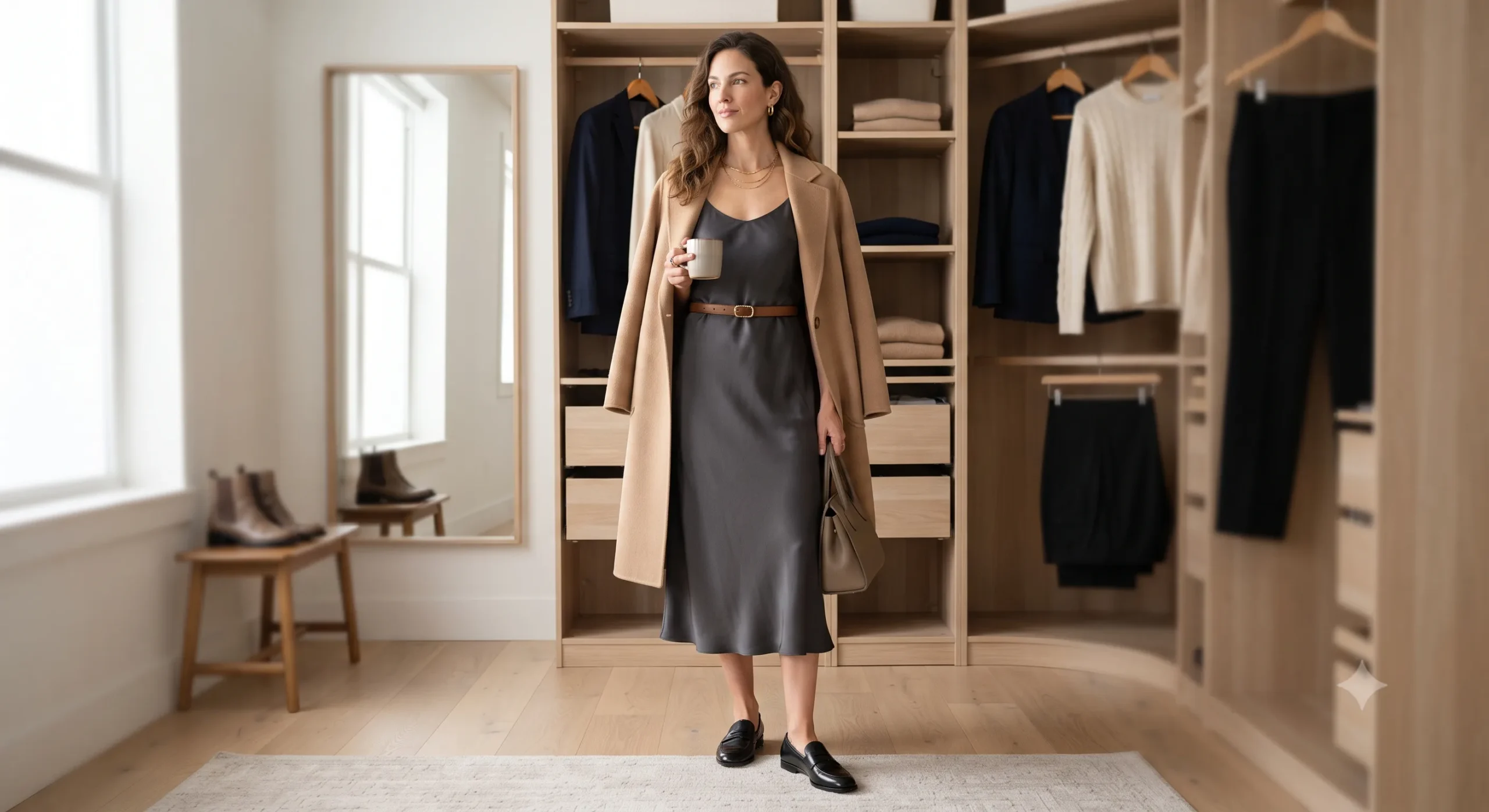
Instead, many stylists lean toward the “rule of thirds.” This involves creating a visual break that follows a 1/3 to 2/3 ratio. This can be achieved by tucking a blouse into high-waisted trousers (1/3 top, 2/3 bottom) or wearing a cropped jacket over a long dress. This creates a more elongated, graceful line that feels naturally pleasing to the eye.
Managing Volume
In a modern romantic wardrobe, we often play with soft structures—pieces that are neither skin-tight nor excessively baggy. The key to mastering volume is balance.
- If the bottom is voluminous (e.g., wide-leg trousers), the top should generally be more fitted or structured to provide a point of reference for the body.
- If the top is oversized (e.g., a relaxed masculine-style shirt), the bottom should be more streamlined (e.g., straight-leg denim or a slim skirt) to prevent the silhouette from becoming lost in fabric.
Decision Framework: How to Evaluate a New Piece
When you are considering a new addition to your closet, move past the initial impulse of “I like this” and run the garment through this diagnostic checklist. This is how you ensure every piece earns its place in a considered style.
The Three-Point Check
- The Movement Test: When you put the garment on, move. Sit down, reach up, and walk. Does the fabric bunch uncomfortably? Does the hem rise too high? Does it feel restrictive or liberating? A garment that feels like a costume will never become a staple.
- The Versatility Scan: Can you name at least three different ways to wear this? A piece that only works with one specific pair of shoes or one specific blouse is a “single-use” item. An intentional wardrobe thrives on pieces that can transition from a professional setting to a casual weekend or an evening event with minimal changes.
- The Material Audit: Look at the composition label. If the garment is a blend, ensure the primary fiber is of a high quality. Does the weight of the fabric match the intended use? (e.g., a heavy wool for a summer dress is a functional mismatch).
Common Pitfalls in Achieving Understated Style
Even with the best intentions, it is easy to fall into traps that undermine a polished look. Recognizing these patterns is the first step toward refining your aesthetic.
- The “Trend Trap”: Buying a piece because it is “in” rather than because it fits your existing proportions. Trends often rely on exaggerated silhouettes (extreme cropped lengths or extreme oversized shapes) that are difficult to integrate into a timeless wardrobe.
- Neglecting the Details: A beautiful dress can be ruined by a cheap, plastic button or a visible, poorly finished seam. In quiet luxury, the details are the main event.
- Over-accessorizing: When the focus is on fit and fabric, the clothes should stand on their own. Excessive jewelry or loud belts can distract from the subtle sophistication of the garment’s construction.
- Ignoring Maintenance: A well-fitted, high-quality wool coat loses its elegance the moment it becomes covered in lint or loses its shape due to improper hanging. Part of the “luxury” of these pieces is the commitment to their care.
Conclusion: The Quiet Power of Intentionality
Mastering fit, fabric, and proportion is not about following a set of rigid rules; it is about developing an intuition for how clothing interacts with the physical world. It is a shift in perspective—from seeing clothes as mere decoration to seeing them as structural elements of your daily life.
When you prioritize the way a fabric drapes, the precision of a seam, and the balance of a silhouette, you are no longer chasing the ephemeral high of fashion. Instead, you are building a wardrobe of purpose—one that provides not just aesthetic pleasure, but a sense of composed, effortless grace. In the end, the most sophisticated way to dress is to let the quality of the garment and the character of the woman speak for themselves, without the need for a single logo.