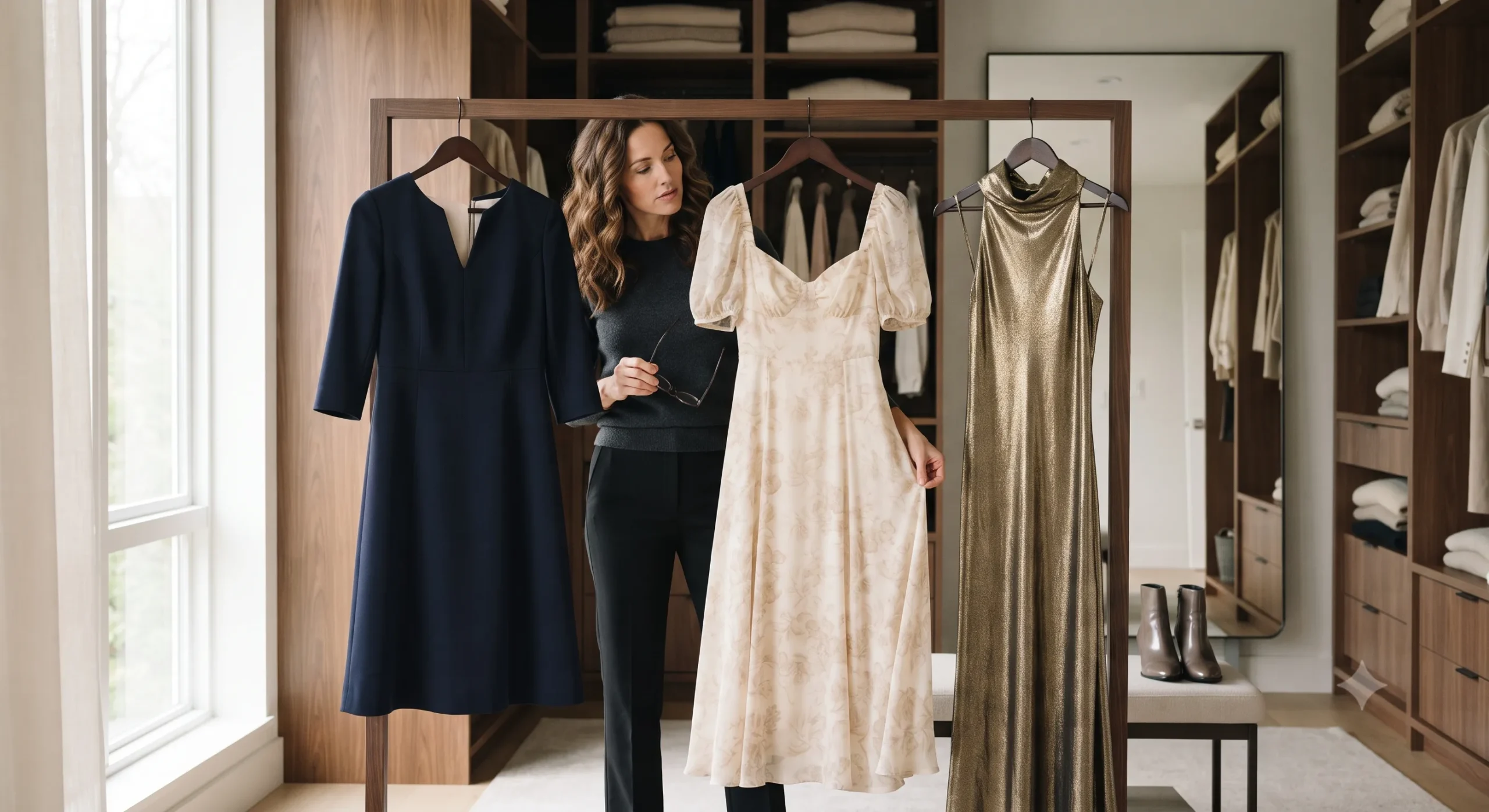
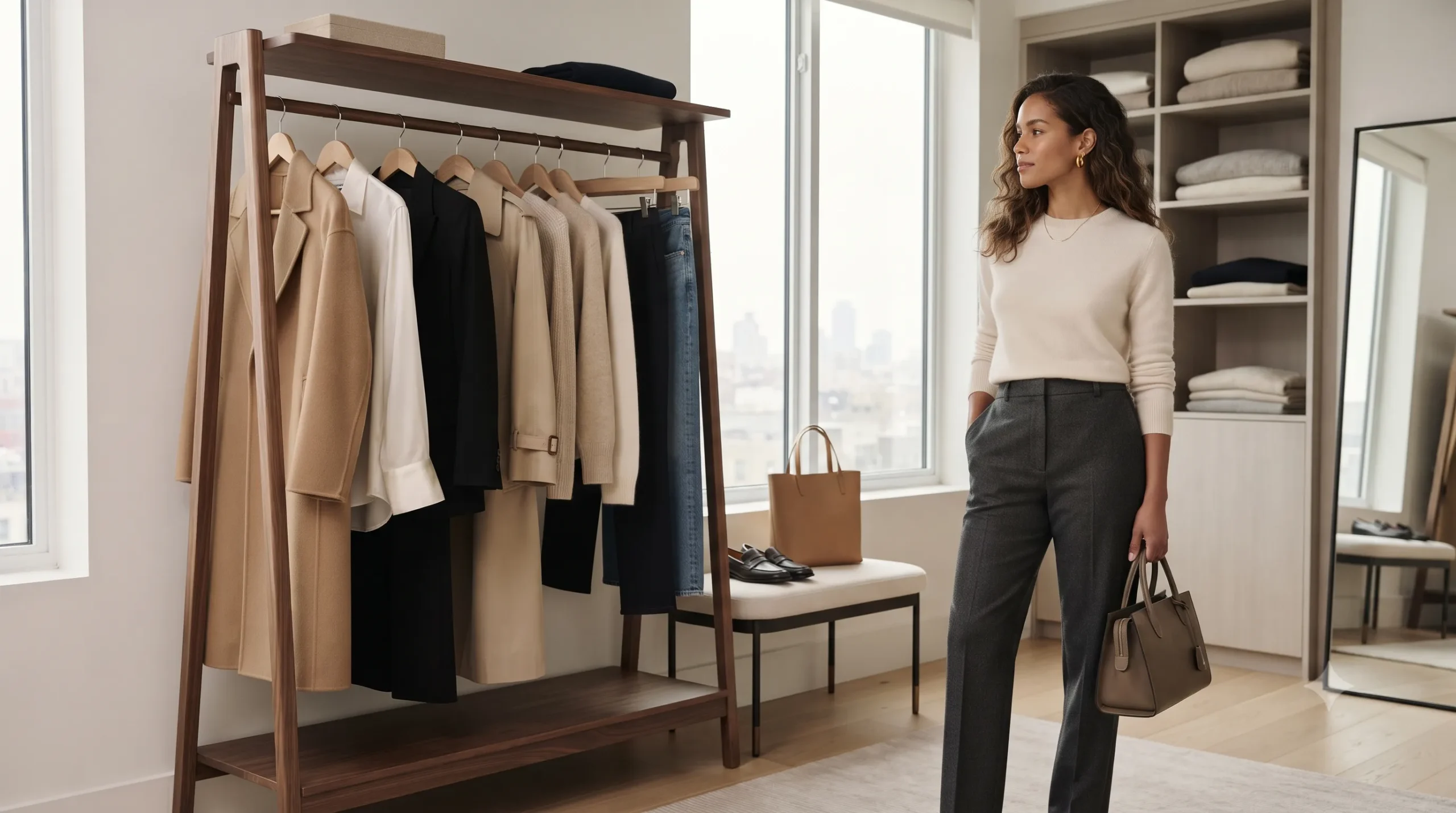
There is a specific kind of mental fatigue that sets in around 7:00 AM, staring into a closet that feels simultaneously too full and entirely empty. You have plenty of clothes, yet none of them seem to “work” for the day ahead. You find yourself caught in a cycle of decision paralysis: Is this too casual for the meeting? Is this too trendy for a Tuesday? Does this silhouette feel outdated?
The impulse to overthink often stems from a desire to be “correct”—to match a fleeting trend or to signal a specific status. But for many women, the goal isn’t to perform fashion; it is to inhabit it. Dressing well shouldn’t feel like solving a complex math equation every morning. Instead, it should feel like a calm, predictable ritual.
To dress well without the mental tax, one must shift the focus from what to buy to how to choose. It requires moving away from the urgency of trends and toward a logic of cohesion. When your wardrobe is built on a foundation of reliable proportions, harmonious colors, and versatile pieces, the “decision” is already made before you even open your closet door.
The Philosophy of Low-Cognitive Dressing
The secret to effortless dressing is not actually effortlessness; it is preparation. In the world of high-level styling, this is often referred to as building a “modular” wardrobe. A modular wardrobe is one where the components are designed to interact with one another by default.
When you overthink, you are usually treating every outfit as a brand-new problem to solve. You are looking at a skirt and wondering what top will save it. This is exhausting. Low-cognitive dressing asks you to flip the script: you select pieces that are already “speaking the same language.”
This language is composed of three main pillars:
- Color Cohesion: A palette that allows for spontaneous mixing.
- Proportional Intelligence: Understanding how volume and shape balance each other.
- Texture and Weight: Ensuring the “feel” of the outfit remains consistent.
By establishing these pillars, you create a system of “automatic” styling. You aren’t deciding what to wear; you are simply selecting from a pre-approved set of harmonious options.
Building a Foundation of Cohesive Colors
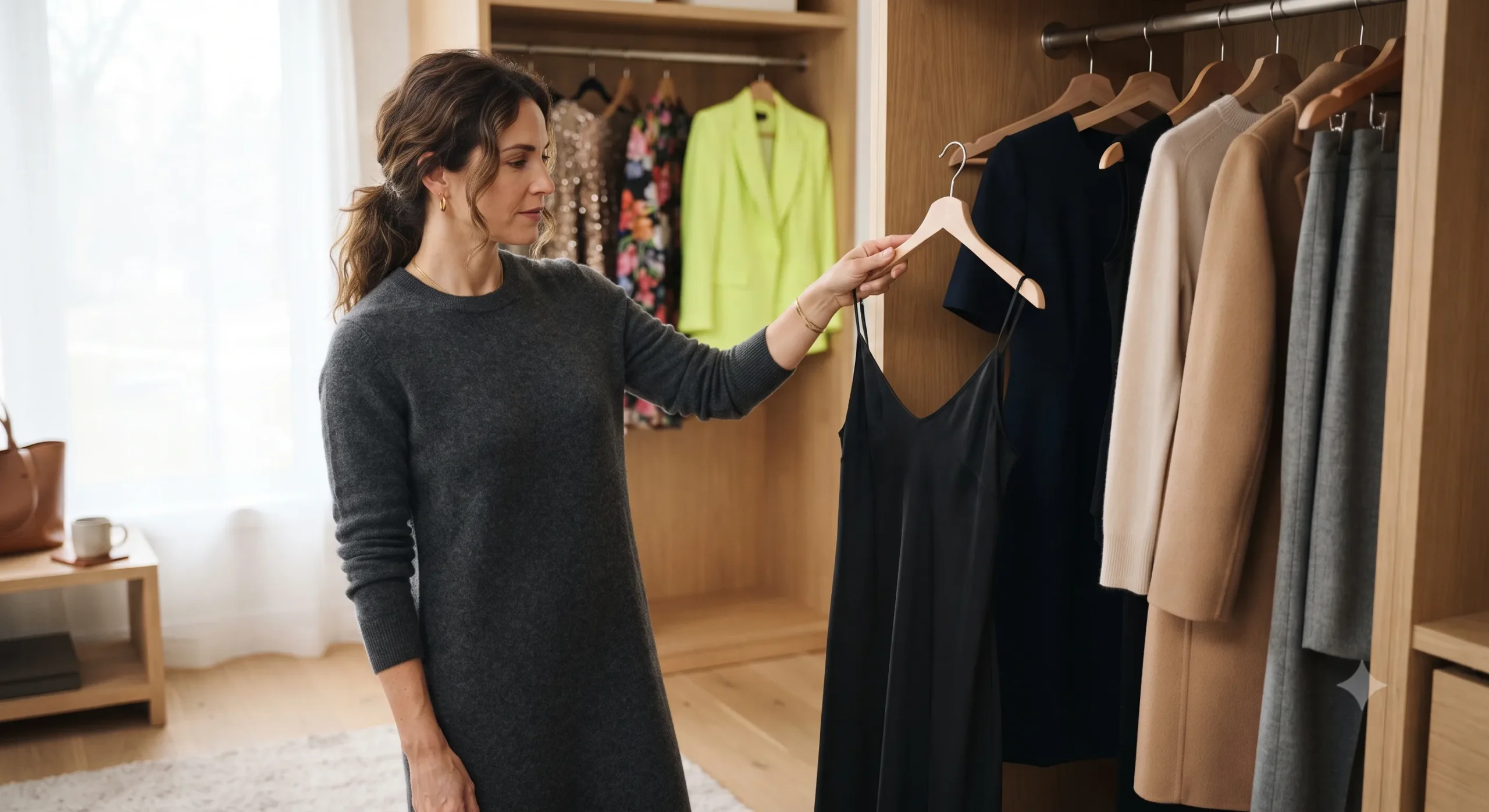
The most common reason for decision fatigue is a lack of color connectivity. If you own a bright neon green top, a mustard yellow skirt, and a pastel lilac blazer, you have created a wardrobe of soloists. These pieces are difficult to pair because they compete for attention rather than supporting one another.
To minimize overthinking, lean into a palette of “interchangeable neutrals” accented by a few signature tones. This does not mean you must wear only beige and black. It means your colors should share a similar tonal temperature or depth.
The Rule of Tonal Harmony
A simple way to avoid mistakes is to shop within a specific tonal family. For example, if you prefer warm tones, your wardrobe might consist of creams, camels, olives, and terracotta. If you prefer cool tones, you might lean toward navy, charcoal, soft blues, and crisp whites.
When your colors are harmonized, you can reach into your closet, grab any top and any bottom, and the result will likely look intentional. This is the essence of quiet luxury: the beauty lies in the subtle, seamless transition between shades, rather than the jarring contrast of competing colors.
Using “Bridge” Colors
If you do want to incorporate color, use “bridge” pieces. A bridge piece is a garment that contains multiple colors from your palette or acts as a neutral ground. A navy sweater might bridge a cream trouser and a light blue button-down. A patterned scarf that incorporates your primary neutrals can also serve as a tool to pull disparate pieces together.
The Logic of Proportion and Silhouette
Even with a perfect color palette, an outfit can feel “off” if the proportions are unbalanced. This is often where the overthinking begins. We stand in front of the mirror, feeling like something is wrong, but we can’t quite name what it is. Usually, it is a conflict of volume.
A useful rule of thumb for consistent, easy dressing is the Principle of Counterbalance.
- If the bottom is voluminous (e.g., wide-leg trousers or an A-line skirt), the top should be more structured or fitted (e.g., a tucked-in knit or a tailored shirt).
- If the top is oversized (e.g., a boyfriend blazer or a heavy knit), the bottom should be more streamlined (e.g., straight-leg denim or a slim midi skirt).
Defining “The Anchor”
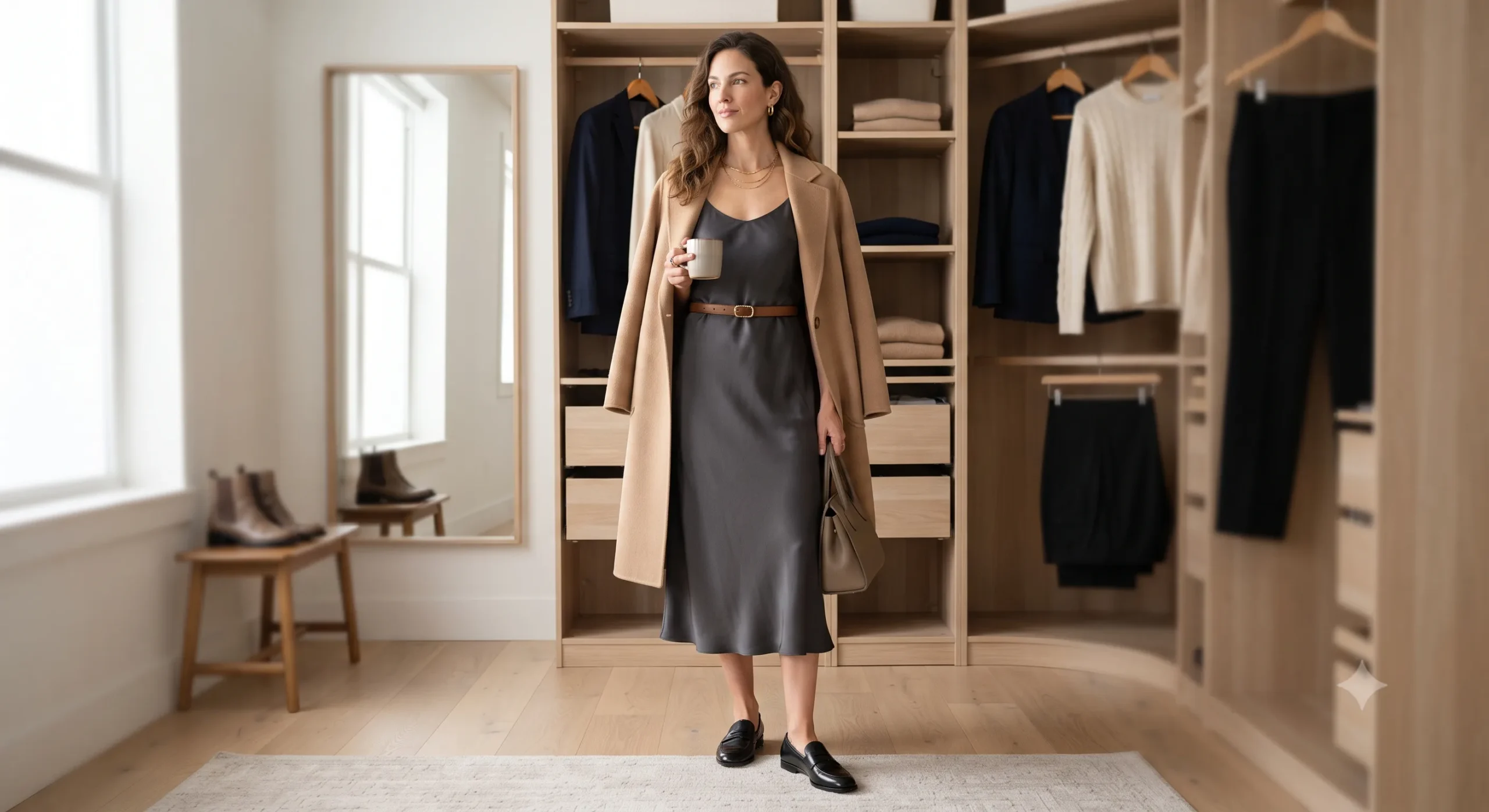
Every successful outfit needs an anchor—a piece that provides structure. In a very soft, romantic outfit consisting of a flowing skirt and a draped blouse, an anchor might be a structured leather belt or a tailored coat. The anchor prevents the outfit from looking shapeless or “pajama-like,” providing the visual clarity that makes an outfit look polished.
| Outfit Component | Option A (Voluminous) | Option B (Streamlined) | The “Easy” Result |
|---|---|---|---|
| Bottoms | Wide-leg linen trousers | Slim-fit cigarette pants | Balance of shape |
| Tops | Oversized cashmere sweater | Tucked-in silk blouse | Visual weight management |
| Outerwear | Long, sweeping trench | Cropped, structured jacket | Proportion control |
The Decision Matrix: Choosing Outfits for Real Life
Instead of asking “What looks good?” ask “Where am I going, and how do I want to feel?” This shifts the question from aesthetics (which are subjective and tiring) to utility (which is objective and easy).
To stop the morning spiral, categorize your life into three or four primary “modes.” Most women’s lives fluctuate between these categories:
- The Professional/Structured Mode: Meetings, client lunches, formal presentations. (Requires tailoring and structure).
- The Creative/Social Mode: Coffee dates, gallery visits, casual dinners. (Allows for more texture and romantic softness).
- The Active/Errand Mode: Travel, grocery runs, walking the dog. (Prioritizes comfort and durability).
- The Occasion Mode: Weddings, formal events, celebrations. (Focuses on elegance and intentionality).
Scenario-Based Decision Making
By assigning specific “uniforms” to these modes, you eliminate the need to reinvent yourself every day.
- Scenario: A Tuesday morning with back-to-back meetings.
- The Logic: You need to feel authoritative but comfortable.
- The Formula: Structured trousers + a high-quality knit + a loafer.
- Scenario: A Saturday afternoon at a local cafe.
- The Logic: You want to feel relaxed but polished.
- The Formula: Straight-leg denim + a romantic blouse + a ballet flat.
When you have these mental templates ready, you aren’t searching for an outfit; you are simply selecting the version of your “mode” that fits the weather.
Avoiding the “Trend Trap” and Common Mistakes
One of the greatest contributors to wardrobe anxiety is the pressure of the trend cycle. When we buy pieces based on what is currently “in,” we often find ourselves with a closet full of items that don’t work together. A heavily embellished trend piece rarely plays well with a minimalist staple.
Common Pitfalls in Effortless Dressing
- The “Single-Use” Purchase: Buying a garment that only works for one specific, fleeting trend. If a piece cannot be worn with at least three things you already own, it is a source of future decision fatigue, not a solution.
- Neglecting Fabric Integrity: Buying clothes that look good on the hanger but lose their shape after two hours of wear. If a garment wrinkles excessively or loses its silhouette, you will spend your day “adjusting” it—which is a form of overthinking.
- Over-Accessorizing: When you are unsure of an outfit, the instinct is often to add more jewelry, more layers, or more color. This usually creates visual noise. If an outfit feels “incomplete,” try removing one thing rather than adding more.
The Cost-Per-Wear Perspective
A useful way to decide if a piece is worth the mental energy is to consider its long-term value. A dress that earns its place in your wardrobe is one that works for more than one kind of day. A high-quality midi dress can be worn with a blazer for work, with sneakers for a weekend walk, or with elegant heels for a dinner. This versatility is the ultimate antidote to overthinking.
A Practical Checklist for a Thoughtful Wardrobe
If you want to audit your current wardrobe to make future mornings easier, use this checklist to identify your “low-cognitive” heroes.
- Color Check: Can I pick any top and any bottom from my closet and have them match?
- Proportion Check: Do I have enough “counterbalance” pieces (e.g., if I have many wide skirts, do I also have many fitted tops)?
- Texture Check: Do I have a mix of weights (e.g., structured cotton, soft knits, lightweight linens) to allow for layering?
- Condition Check: Are my core pieces well-maintained? (A wrinkled or pilled sweater will always make you feel less confident, regardless of the style).
- Utility Check: Does my wardrobe reflect my actual lifestyle, or am I dressing for a version of myself that doesn’t exist?
Moving Toward a Calmer Style
Dressing well is not about the complexity of the outfit, but the clarity of the intention. When we strip away the need to impress, to follow, or to perform, we are left with the simple pleasure of clothing that fits our lives.
A thoughtful wardrobe is a tool that serves you; it is not a burden you must carry. By focusing on color cohesion, balanced proportions, and situational utility, you move away from the frantic energy of “getting dressed” and toward the calm grace of simply being present in your clothes. The best wardrobe decisions often feel calm rather than urgent. They don’t demand your attention; they simply support your life.